
Hobby blog of an inveterate omnigamer
Last year I went all-in on a single game; this year I let my omnigamer flag fly and tried a bunch of new systems:
Pros and cons to this approach. My schedule was unquestionably over-ambitious (which I knew going in), and I wouldn’t do two tournaments across two new-to-me systems again—it’s just exhausting, especially over successive days. But everything I did in the historicals venue was an absolute joy (I’m starting to think the optimal Adepticon experience might not leave the Hyatt Regency), and I found one game that shot straight to the top of my hobby pile.
Taking my events in chronological order…
I was a little nervous about this one—I’d heard consistently good things about this event, including that it was a good place to get your feet wet with Bolt Action, but I wasn’t sure what kind of vibes to expect.
Everyone I played with was generous and upbeat and welcoming; the hobby standard was incredibly high; folks had historical background sheets printed for their thoughtfully curated armies…it was just lovely across every dimension. It was also hands-down the best-run event I’ve ever played in, and I’ve played in some really well-run events over the last year and change (the BattleTech Triangle Classic and last year’s Heresy events at Adepticon come to mind).
Originally, I started looking into Bolt Action because I thought I could play it with my dad, because I’d accumulated a number of free British infantry sprues, and because I was intrigued by the Rick Priestley pedigree. But as I researched and developed my army, I pretty quickly appreciated that I had quickly learned more about the basic arc and contours of World War II and the European theater (where my own grandfather fought in) than I had ever picked up through schooling or general osmosis. I’m increasingly appreciative of wargaming’s capacity to serve as a lens and anchor for learning, and I was surprised by how much I learned from other players’ armies and interests and research.
The games were 450 points (with a few notable house rules in place) and themed around the mid-to-late war period. I ran…
British Reinforced Platoon
Special Rule: Rapid FireSecond Lieutenant
Regular Infantry Section (x6, equipped with rifles)
Commando Section (x6, equipped with anti-tank grenades)PIAT Team
Light Artillery (Light howitzer, 25 pdr)British Airbone Recce Jeep (Forward-facing twin MMGs)
Bren Carrier (Forward-facing LMG)
The list was probably better than the player here. I went 1-2, which I was perfectly happy with as a first-timer, and I always felt like I had the tools I needed for the mission. Favorite moment was definitely my PIAT team doing their exact job and hopping out of their Bren Carrier to wipe out a Panther, clearing the flank and helping to facilitate the British win.
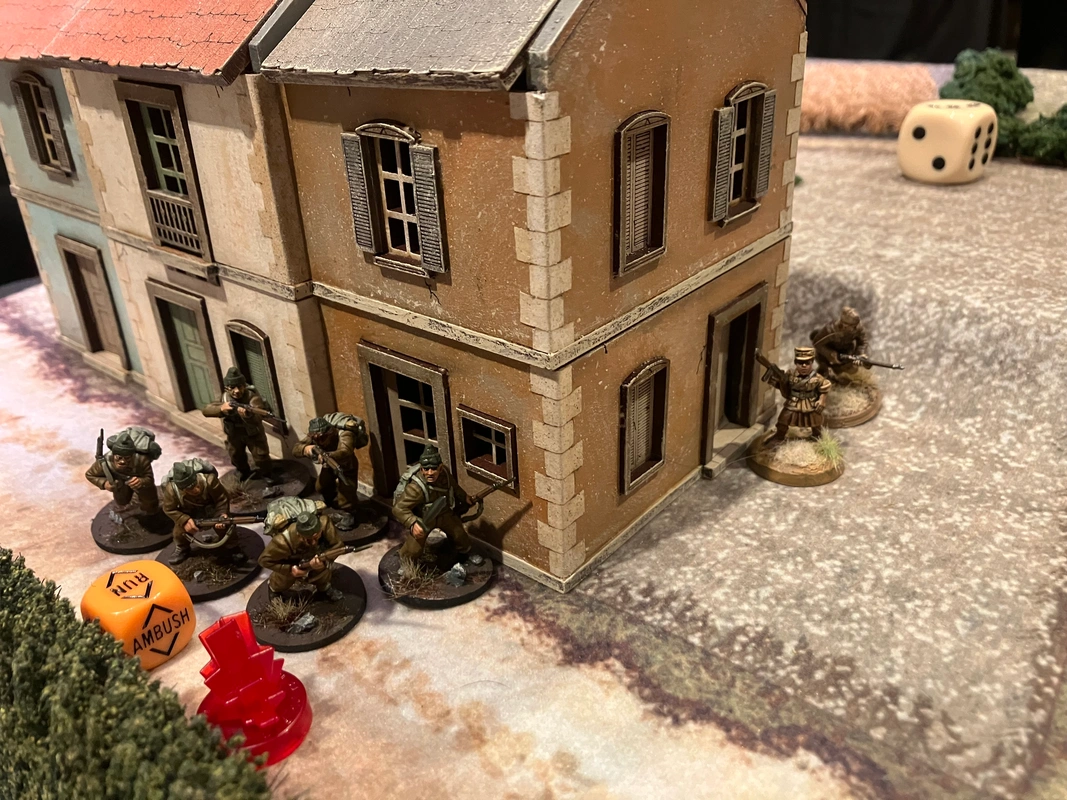
In the future, I could stand to be a little more adaptable with my lieutenant—he tended to hang in the Bren Carrier so that it wouldn’t be empty and therefore auto-destroyed by enemy proximity, but in at least one game it would have been much more useful to have him near the artillery for orders.
Both the rules and my army felt great to play—I definitely want to expand my army and spend more time with Bolt Action, and I could easily imagine focusing on it at future Adepticons.
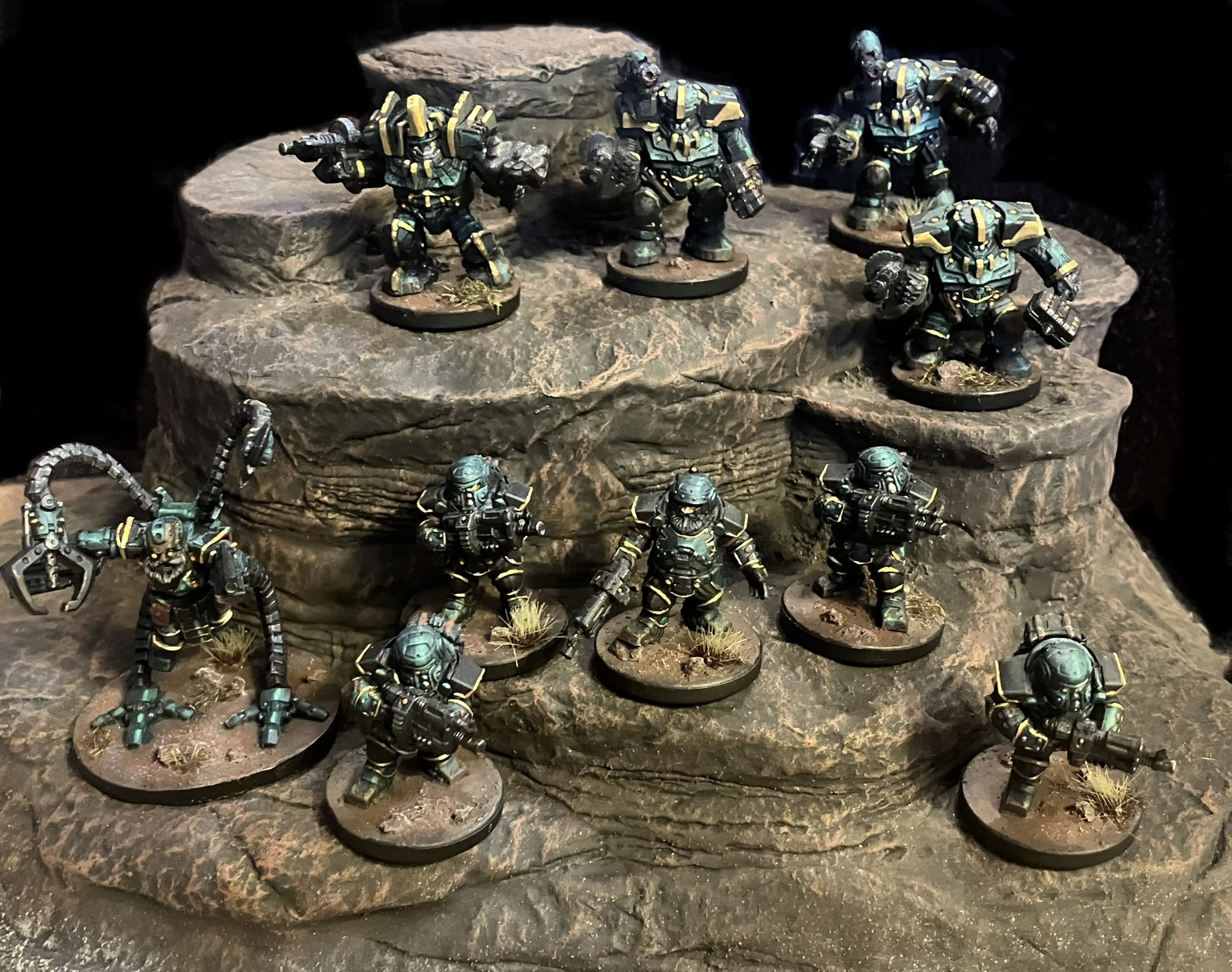
I’ve been working on some Forge Fathers (Space Dwarves) for several months, and I’m really pleased with how they’ve come out.
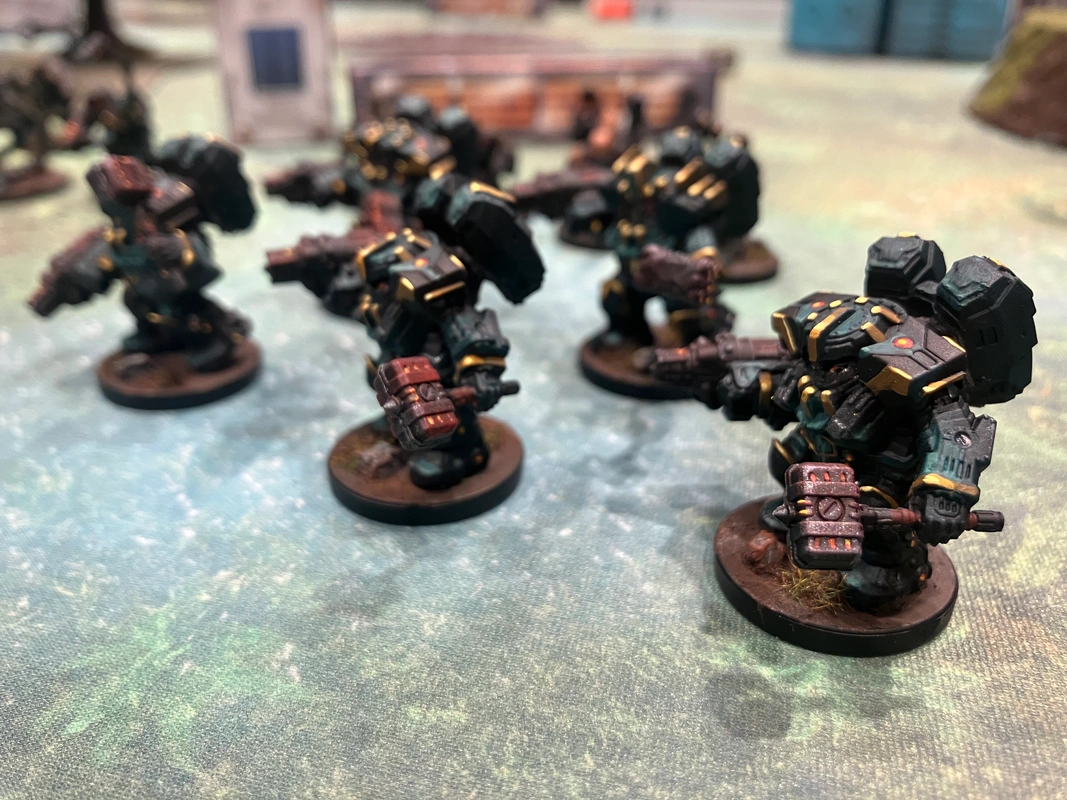
It was a nicely run event and I played some great and gracious opponents (including Jeremy from the Counter Charge podcast), going 2-1 and placing smack in the middle of the pack. My list:
MASTER ARTIFICER (Command) [154]
MASTER ARTIFICER [+5] Default Loadout / Mechnical Appendages - - Paired Burst Pistols / Saw and Claw / Mechanical Appendages
ARTIFICER [+23] - - Magma Rifle / Assault Weaponry / Mechanical Appendages
ARTIFICER [+23] - - Heavy Forge Hammer / Mechanical Appendages
ARTIFICER [+23] Default Loadout / Mechnical Appendages - - Burst Pistol / Light Forge Hammer / Mechanical AppendagesKARFI COMMAND TANK (Command) [110]
KARFI - - Karfi Hailstorm Rifle / RammingBROKKR (Troop) [65]
BROKKR [+5] - - Magma Rifle / Assault Weaponry
BROKKR x 3 - - Burst Pistol / Light Forge Hammer
BROKKR LEADER - - Burst Pistol / Light Forge HammerDRAKKAR APC (Troop) [80]
DRAKKAR - - Mk2 Hailstorm Rifles / RammingTHORGARIM (Troop) [90]
THORGARIM x 4 - - Heavy Forge Hammer
THORGARIM LEADER - - Heavy Forge HammerSTEEL WARRIORS (Troop) [115]
STEEL WARRIOR LEADER - - Mk2 Hailstorm Rifle / Assault Weaponry
STEEL WARRIOR [+15] - - Mjolnir Missile Launcher / Assault Weaponry
STEEL WARRIOR x 3 - - Mk2 Hailstorm Rifle / Assault WeaponrySTEEL WARRIORS (Troop) [115]
STEEL WARRIOR LEADER - - Mk2 Hailstorm Rifle / Assault Weaponry
STEEL WARRIOR [+15] - - Mjolnir Missile Launcher / Assault Weaponry
STEEL WARRIOR x 3 - - Mk2 Hailstorm Rifle / Assault WeaponryKNARR ASSAULT TANK (Specialist) [110]
KNARR ASSAULT TANK - - Assault Grenade Launchers / RammingHAMMERFIST DROP TROOPERS (Specialist) [146]
HAMMERFIST DROP TROOPERS x 4 - - Inferno Drill / Light Forge Hammer
HAMMERFIST DROP TROOPERS LEADER - - Inferno Drill / Light Forge HammerFORGE GUARD (Specialist) [260]
FORGE GUARD x 2 [+40] - - Mjolnir Missile Launcher / Light Forge Hammer / Mk3 Hailstorm Rifle
FORGE GUARD - - Mk3 Hailstorm Rifle / Forge Hammer
FORGE GUARD LEADER - - Mk3 Hailstorm Rifle / Forge Hammer
FORGE GUARD x 2 - - Mk3 Hailstorm Rifle / Forge Hammer
I think I need to get a couple more games in to nail down my thoughts on the played experience of the system. I had the most fun by far in the game I lost (against Jeremy, also playing Forge Fathers), in which I was totally spent and just YOLO-ing my dudes forward, and which consequently had some glorious moments like a dwarf mech with a giant hammer thwacking my tank across the board. The games I won (against Marauders/Orks and Veer-Myn/Space Rats) were both close (though my second opponent was a little on tilt and didn’t experience it as such) and didn’t get much past two rounds.
My opponents for the unfinished games were both quite new, like me, so it’s not surprising that games would take longer. But it’s a little unfortunate, since I think most Firefight players in the U.S. probably have some difficulty getting games in and are therefore new. Round times were healthy here, so I think the organizers did a good job taking this into account, but I suspect that as a general rule, smaller points levels (1000?) and smaller boards might help for U.S. events and demo games.
Far and away my best move: a day of chill historicals.
02 Hundred Hours is a WW2 nighttime stealth game from Grey for Now Games that I’d been curious about for a while. I actually won a copy of the starter at the Bolt Action event, so I was particularly happy to give it a try. It was essentially a PVE experience with myself and 5 teammates playing British commandos infiltrating a secret German facility, which was rendered across a beautiful, elaborate multi-stage board that the father and son GMs had built.
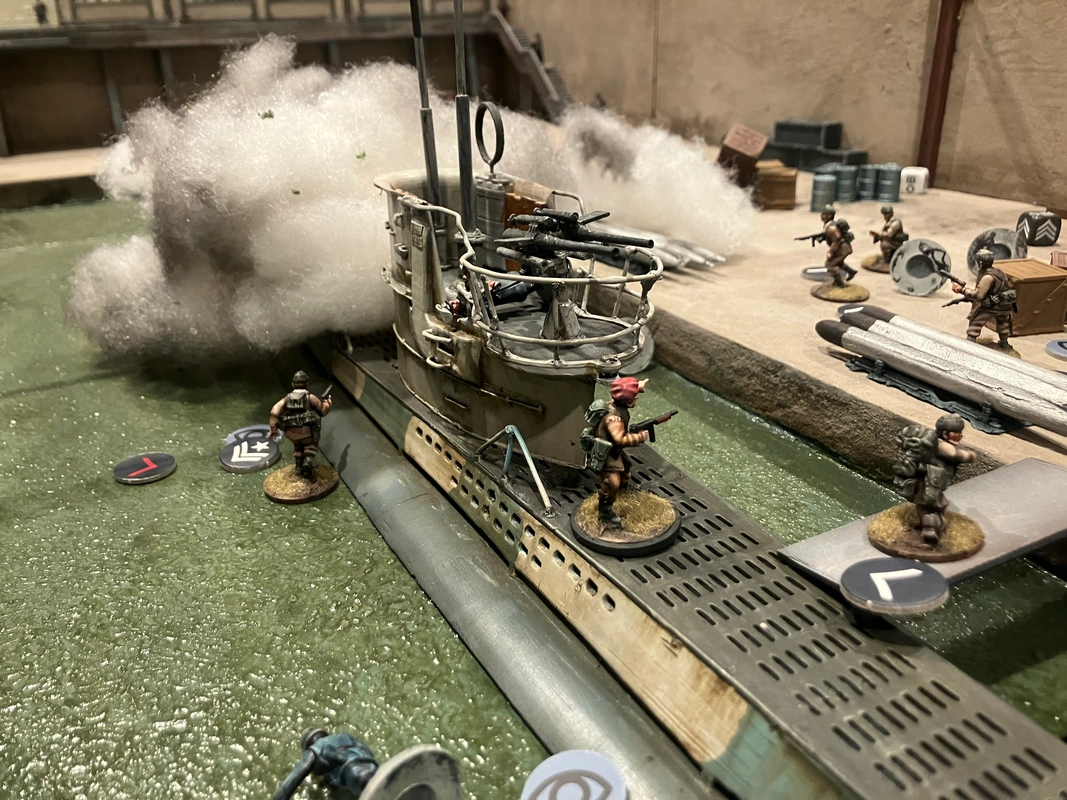
I was randomly assigned to act as the officer, so my model on the table was especially effective and I had a little mini-game in assigning activations, which probably made it extra-fun for me. The system and the experience were great, but I most appreciated the people—especially the GMs, who felt like a model of warm parent-and-child hobbying that I’d love to reach some day.
Blood & Crowns was my last and favorite game and totally took over my hobby imagination. What a system. I didn’t have any experience with the “Blood &” engine, but of course I’d eyed the big boats and I’ve been pretty interested in the Hundred Years War for a while. The GM turned out to be semi-local to me and had set up a beautiful board full of gorgeous models that was well-suited to run a couple basically separate bouts between the French and English. I played the French and (entirely appropriately) fell under the weight of English archery, and I couldn’t have loved it more.
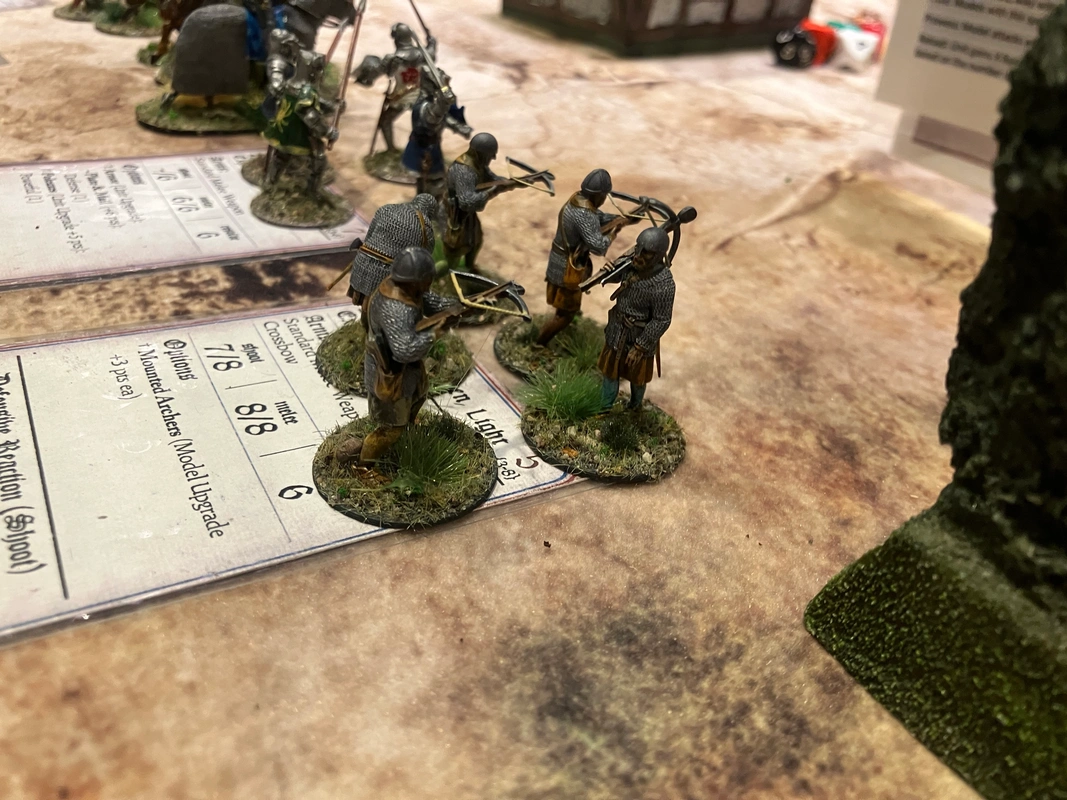
Everything here is just exactly what I want in a wargame: fast-moving, creative and modern with card-based bidding activations, easy to grasp the fundamentals but depthy and crunchy, with lots of optional subsystems that are perfectly suited to narrative play (medieval naval battles!). The rulebook is clearly a labor of love for gaming, hobbying, and the era, and it’s got me both diving back in to HYW reading and pushing myself on painting techniques to do justice to the Perry Agincourt models I bought immediately after the demo game. I’m planning to write more on Blood & Crowns soon, and now I’m very excited to delve into the rest of Firelock’s catalog.
Coming out of Adepticon, I want to pour all of my hobby energy into historicals. There’s a lot of room for variability within that space, but games like Blood & Crowns bring models and terrain and subject matter that I could imagine my son digging some day. I love that you see fathers and sons in this space, like the guys who ran the 02 Hundred Hours game. I’d like to delve much more into terrain and board-building, too. I wish I’d been a little more focused, but I was a little surprised to find my excitement to hobby keener than when I went in.
WIP recipe:
Fine details: Cups (Brown for late war, white with blue rim for early), Canteens (Green-brown), Binoculars (Black)
For an inveterate omnigamer, I was actually pretty focused last year:
I spent the winter building, painting, and playing Horus Heresy, leading up to an excellent Adepticon.
For most of the spring I focused on some 40k 2nd edition-styled Ultramarines in anticipation of 10th edition. It was a fun project! Unfortunately, 10th felt hollow on arrival and isn’t much better now. I might use those models for some Oldhammer down the line, but 40k’s half-assery left me sour on the whole GW catalog.
I spent the summer and fall painting and learning classic BattleTech, which is a joyous warren of rabbit holes (Lore! Paint schemes! Thirty years of rules!). I played—and did unexpectedly well!—in a BattleTech tournament that was an absolute blast, and started some longform BattleTech pieces that I’m planning to post in the new year.
This winter, I started digging into my Mantic-flavored pile of shame, building and painting Forge Fathers (pictured above) for Firefight and Abyssal Dwarves for Kings of War.
I was sort of serially monogamous with games, and it was nice—I spent time in communities that I really enjoyed and identified the semi-competitive-to-narrative niche that I vibe with as I slouch into aged grognardery.
This year, I want to do a better job of being part of gaming communities—sticking around over time, getting to know new people. The fellowship is one of the things that appeals to me most about tabletop gaming, but it’s tough when you’re dad-aged and irregularly available, and even tougher if you keep hopping from game to game.
Every year, I’m surprised by where my whims take me, but in 2024 I hope to focus on:
You stick around in the hobby long enough, this is where you wind up, right? Like how everything turns into crabs.
I’ve been stockpiling Early Imperial Romans for a while, and partly I want to make some progress on my shamepile, but more than that I’ve felt the pull getting stronger and stronger. It’s an area where I could theoretically even throw some dice with my dad (God help me, I’m painting some Bolt Action Brits, and enjoying the list-building, and learning more about WWII).
I’m planning to spend a lot more time on historicals at Adepticon (assuming I’m able to attend), and I’d really like to get to know more of the local community. There are a bunch of Ancients rulesets I’d like to try (Infamy Infamy, Strength & Honor, Hail Caesar) and I hope to work through my Rome & Gaul project sufficiently to run a game. I’m also feeling the pull of Napoleonics at multiple scales—I’ve tried and enjoyed Et sans resultat, and I’m interested in Black Powder (Epic or otherwise), Valour & Fortitude, and Soldiers of Napoleon, among others.
Mantic really don’t get enough credit—their rulesets are fantastic, and their newer plastic models have a wonderful retro-modern quality that makes them uniquely pleasurable to build and paint. I really dig both the Firefight rules and the Forge Fathers model range, and I want to spend more time on Mantic stuff this year. Firefight is my top priority game for Adepticon (again assuming I can attend). Longer term, I hope to complete the Abyssal Dwarf army that I’ve had on the go for an embarrassing amount of time and play some Kings of War locally.
Man, BattleTech is such a delight; I expect this will be my go-to casual game. (Casual in terms of vibes, rather than rules weight.) I already have several Lances painted up and some narrative games on tap—looking forward to working on some more terrain and to the Mercenaries Kickstarter coming in (with a lot of fun vehicles in tow).
These are probably the outer limits of a reasonably scoped hobby plan, but…
…of course, an omnigamer tends to get seized by whims, and it’s fun to try and predict which whims will do the seizing.
While I remain exhausted with GW—and the exhaustion clearly saved me from wasting time and money on Legions Imperialis—I am Old World-curious. The rules look promising, the design team is solid and seemed to have time to get it right, and I have most of an Empire army in a suitable state of semi-progress. Elsewhere in Specialist Games, I have a Blood Angels army that I’d still like to finish. Outside of modern/supported GW, my unpainted Warmaster models have been grabbing my eye, and I’d like to give Conquest a go at some point. I’m in a real rank-and-flank mood.
Prediction-wise, the slightly hotter takes are perhaps the games I think I won’t get into:
Age of Sigmar 4th ed - I’ll cheerfully acknowledge if I’m wrong (or hang my head in shame if I’m right but the hype gets me), but I expect they’ll fuck it up. 3rd edition is very good. There is simply no need for a new edition right now, and messing with a good thing because you need to grow shareholder value is not a design philosophy. After 10th edition 40k, I’ll be looking at this with maximum skepticism.
40k 10th ed - I’m not planning to sell all of my 40k stuff, but I’m selling a lot of my 40k stuff. Might play some Rogue Trader or 2nd ed, though!
I was going to enumerate more games and companies I’m not jiving with, but on second thought, here’s a hobby goal: I want to spend time writing about games that bring me joy—the painting, the strategy, the history and lore…especially when it’s all grounded in thoughtful, beautiful games designed and orchestrated by passionate people. The joys and the people are, after all, the point.